

Table of Contents
Light travels through a fibre bend radius by bouncing along the boundary between the core and the cladding. That trick only works while the glass runs fairly straight. Bend it too sharply and some of the light escapes, the signal weakens, and in the worst case the glass cracks. Nothing looks wrong from the outside, which is exactly why bend radius problems are so easy to cause and so hard to find.
This guide explains what bend radius is, what happens when you ignore it, the numbers to follow, and how to protect your fiber in everyday installs.
What Is Bend Radius?
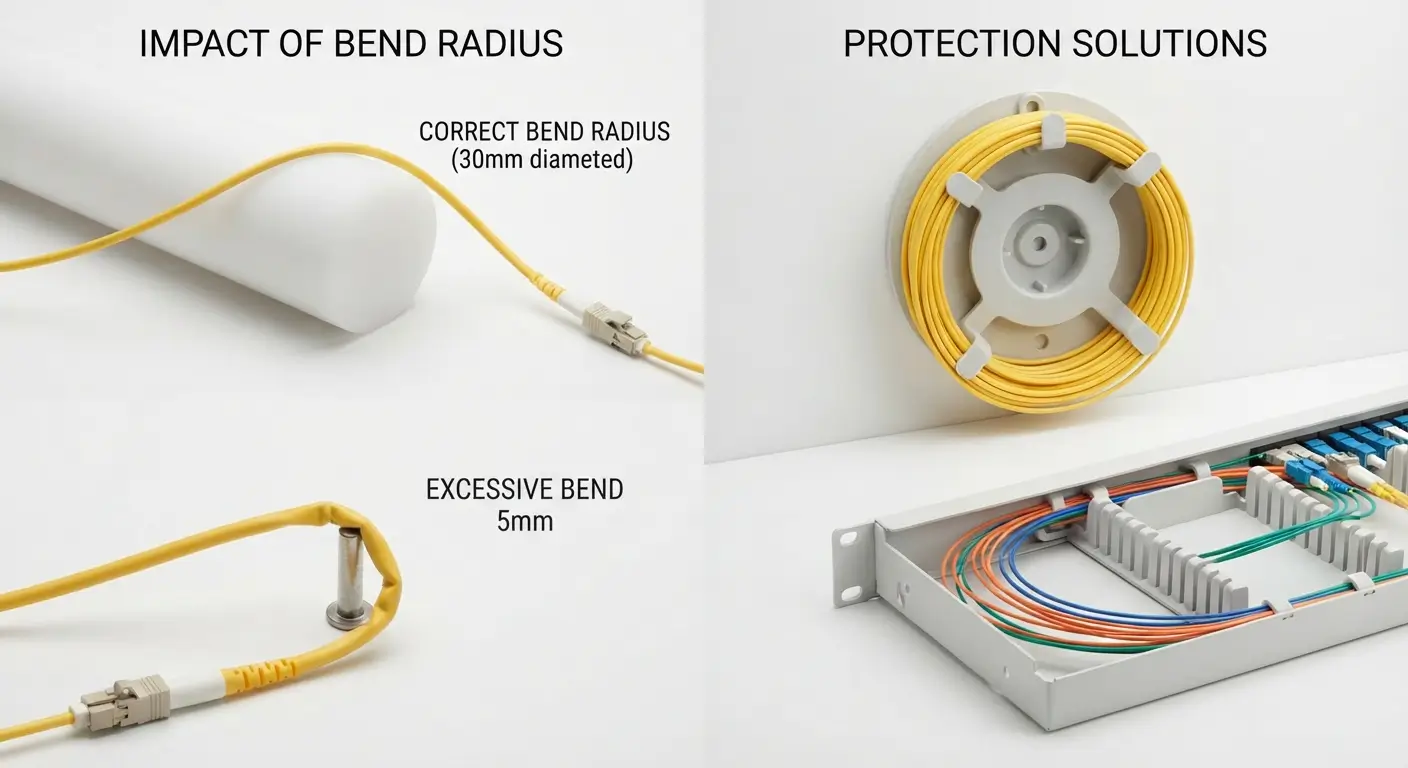
Fibre bend radius is the radius of the curve a fiber or cable makes when it turns. A gentle sweeping loop has a large radius. A kink or a tight corner has a small one.
The minimum fibre bend radius is the tightest curve the fiber can safely follow without unacceptable loss or long-term damage. Manufacturers publish it for every cable, and it depends on construction, diameter, and whether the cable is under tension.
Why Tight Bends Cause Problems
Macrobending Loss
When a fibre bend radius is beyond its limit, light that should stay in the core strikes the cladding at too steep an angle and leaks out. This is macrobending loss. The result is higher attenuation, weaker signal at the receiver, and sometimes complete link failure.
Longer wavelengths leak out more easily, so a bend that barely affects 1310 nm can cause noticeable loss at 1550 nm. This is a useful diagnostic clue when testing, since a splice-like loss that is much larger at 1550 nm than at 1310 nm often points to a tight bend. Our OTDR guide shows how to spot this on a trace.
Microbending Loss
Microbending comes from tiny, repeated distortions, usually from pressure points. Examples include a cable crushed under a heavy load, a tight cable tie, or a fiber pressed against a rough edge. The losses are small individually but add up, and they often appear only in certain temperatures or positions, which makes them especially frustrating.
Long-Term Mechanical Damage
Beyond signal loss, glass under bending stress gets weaker over time. Microscopic surface flaws can grow into cracks, and a link that works today may fail months later. Tight bends are a reliability risk, not just a performance risk.
Typical Bend Radius Numbers
Always follow the datasheet, but these figures are common reference points.
- Bare or buffered fiber (standard G.652D singlemode): about 30 mm minimum
- Bend-insensitive G.657.A1: about 10 mm
- G.657.A2: about 7.5 mm
- G.657.B3: about 5 mm
- Jacketed patch cords and indoor cable: commonly 10 times the cable’s outer diameter when installed, and about 20 times during pulling or under tension
- Outdoor and armored cable: often 15 to 20 times the diameter, depending on construction
Two rules follow from these numbers. First, the limit is larger when a cable is under load, so be extra careful when pulling. Second, “bend-insensitive” fiber tolerates tight curves but does not cancel the rules. It still needs sensible handling.
Where Bend Radius Is Most Often Violated
Bends go wrong in predictable places:
- Inside enclosures, where pigtails and slack are crammed into small spaces
- Behind patch panels, where cords are pushed back to close the door
- At cable entries and corners, where cables turn sharply
- In conduits and trays, especially at elbows
- At wall outlets and faceplates, where shallow boxes force sharp turns
- During pulling, when the cable snags and takes tension on a corner
- Under staples and ties, where cables are squeezed
If you have ever shut a patch panel door on a bundle of cords, you have probably exceeded the limit somewhere.
How to Protect Fiber From Bending Damage
- Plan the Route Before You Pull Check the path for corners, tight turns, and pinch points. Use wide-radius elbows and sweeping bends in conduits. A few extra minutes of planning prevents most problems.
- Use Bend-Radius Guides and Spools Quality patch panels, closures, and distribution boxes, including fibre bend radius guides, rings, and spools that hold fiber in gentle loops. Use them rather than improvising. When choosing hardware, look for these features, as covered in our fiber distribution box checklist.
- Manage Slack Neatly Leave service loops, but coil them in smooth, generous curves, never tight bundles. Our guide to managing slack and splice trays shows how to store fiber safely inside enclosures.
- Control Pulling Tension Use the correct pulling grips, respect the maximum tension rating, and pull smoothly. Avoid jerking and never pull around a sharp corner. Lubricate and use pulleys where needed.
- Fasten Gently Use hook-and-loop straps instead of tight plastic cable ties. Tighten only enough to hold the cable, and leave room for the jacket to move slightly.
- Choose the Right Fiber for the Job In tight spaces, such as multi-dwelling unit risers, wall outlets, and high-density panels, bend-insensitive G.657 fiber gives extra margin. It costs a little more, but it forgives the inevitable tight turns of real-world installs.
- Respect Patch Cord Limits Short patch cords in crowded racks are a common weak point. Choose proper lengths to avoid stretching or looping them tightly, and route them through cable managers rather than letting them hang.
- Train Everyone Who Touches the Network zA careful installer can be undone by a later visitor who stuffs cords behind a door. Make bend radius part of installation standards and maintenance checklists.
How to Check for Bend Problems
If a link shows unexplained loss, bends are a prime suspect.
- Visual inspection: look for kinks, flattened sections, or cables pinched by covers and ties
- Visual fault locator (VFL): a red laser will glow at a macrobend in the jacket, pointing to the problem
- OTDR testing: compare traces at 1310 and 1550 nm, since a bend shows up as a loss that is larger at 1550 nm
- Power meter testing: confirm the end-to-end result after fixing the routing
Fix the routing first, retest, and keep records of the result.
Common Mistakes to Avoid
- Closing doors and covers on cords that are already tight
- Over-tightened cable ties or clamps
- Ignoring the extra margin needed under tension
- Using generic radius numbers without checking the datasheet
- Assuming bend-insensitive fiber needs no care
- Leaving no slack, which forces tight bends at terminations
What is the minimum Fiber Bend Radius of fiber optic cable?
It varies. Many jacketed cables use 10 times their diameter when installed and 20 times when pulled, while bare standard fiber is about 30 mm.
What happens if I bend fiber too tightly?
You get higher signal loss, possible link failure, and long-term damage risk.
Why is loss worse at 1550 nm?
Longer wavelengths are less tightly confined in the core, so they leak out of a bend more easily.
Is bend-insensitive fiber worth it?
Yes, in tight spaces and high-density installs, since it tolerates sharper curves with less loss.
Can a bent fiber recover?
Mild bends can recover once straightened, but a kinked or cracked fiber must be replaced.
Conclusion
Fibre bend radius is one of the simplest rules in fiber work and one of the most often broken. Know your cable’s limit, plan routes with gentle curves, use proper guides and slack storage, and fasten cables loosely. Do that, and your fiber will deliver the loss budget you designed for, year after year.