

Table of Contents
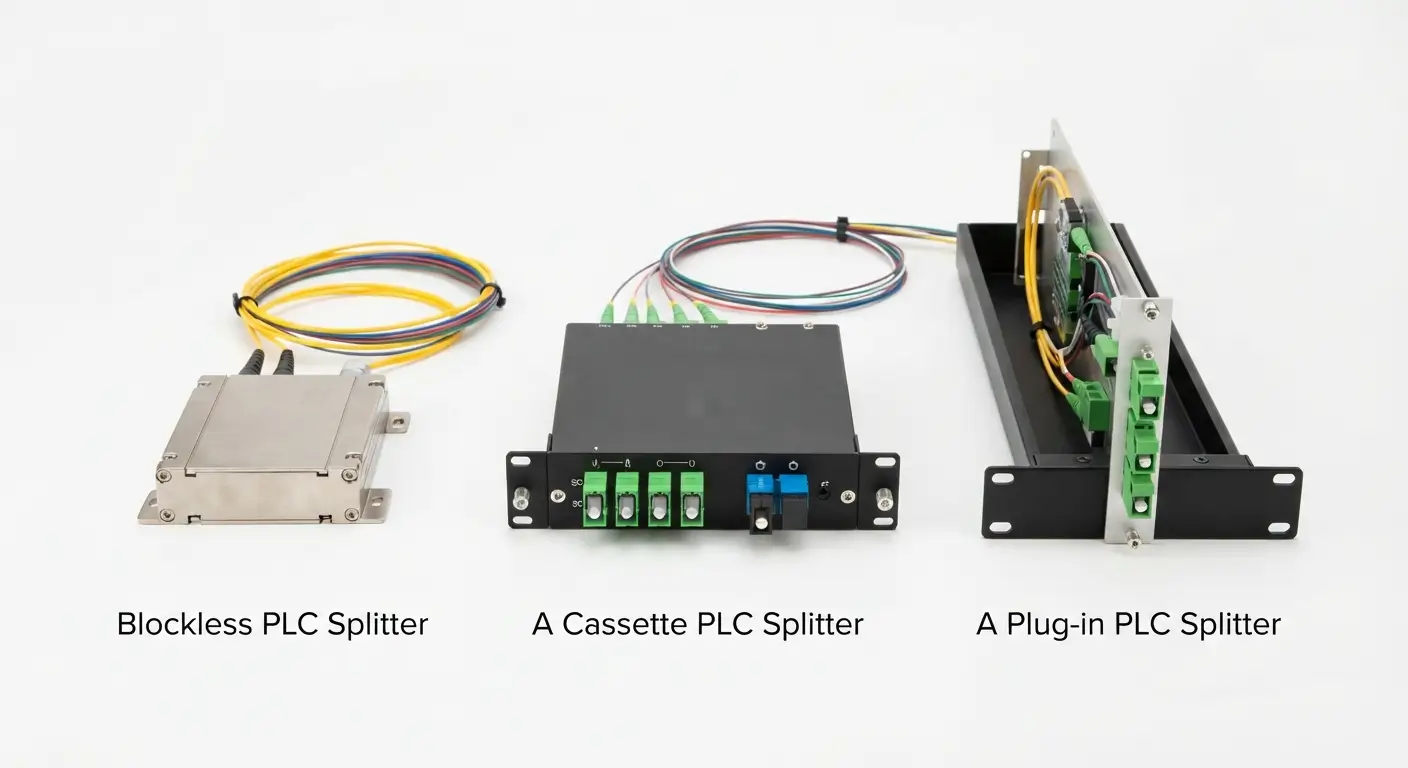
Two PLC splitters can have identical optical performance and still be completely different products. The chip inside is the same. What changes is the package around it, and that package decides where the splitter fits, how easy it is to install, how well it survives, and how painful it is to upgrade later.
If you have ever stared at a product list wondering why a 1×8 splitter comes in three formats, this guide is for you. It explains how blockless, cassette, and plug-in splitters differ and which one fits each situation.
The Optics Are the Same, the Package Is Not
All three types usually contain a PLC (Planar Lightwave Circuit) chip that divides one optical signal into equal outputs. Insertion loss, split ratio, and wavelength range depend on the chip and fiber quality, not on the housing. If you are still deciding between splitter technologies, read our comparison of PLC vs FBT splitters first.
The housing answers a different set of questions. How is the splitter mounted? Does it end in bare fiber or connectors? Can it be swapped without splicing? Those practical details are what separate the three formats.
Blockless Splitters
A blockless splitter is the minimalist option. The chip is protected by a thin tube or light casing, with fiber pigtails coming out of both ends. There is no heavy housing, and the output fibers are typically bare, 0.9 mm, or 2.0 mm cable, with or without connectors.
Where it shines:
- Compact size. It fits inside splice trays, small FTTH boxes, and tight closures.
- Low cost. Less material and packaging means a lower price per unit.
- Clean integration. The splitter becomes part of the splice tray, spliced directly into the network.
Where it falls short:
- Less physical protection. The chip and fibers rely on the enclosure for safety.
- Splicing required for bare-fiber versions, which takes time and skill.
- Harder to replace. Changing the ratio means cutting out and re-splicing.
Blockless splitters suit fixed designs where the split ratio will not change, such as an FDB/NAP box on a pole or a wall-mounted distribution point.
Cassette Splitters
A cassette splitter puts the PLC chip inside a plastic ABS or metal housing, often with connectorized pigtails or adapters on the front or sides. Cassettes may be fixed units that mount in a panel, or compact boxes that sit on a shelf or a tray.
Where it shines:
- Better protection. The rigid housing shields the chip and the fiber routing.
- Connectorized outputs. SC or LC connectors let you patch rather than splice.
- Easy handling and labeling. The body is solid, easy to grip, and easy to tag.
- Flexible placement. Works in boxes, shelves, and rack panels.
Where it falls short:
- Larger than blockless. It takes more space in a small enclosure.
- Slightly higher cost.
- Connector points add loss. Each mated connector contributes a small amount of insertion loss.
Cassette splitters fit environments where handling matters: central offices, equipment rooms, and field boxes that need quick, patched connections.
Plug-in Splitters (LGX)
A plug-in splitter is a cassette designed to slide into a standard slot, often called LGX format. It has adapters built into the front panel, so you connect the incoming and outgoing patch cords like you would on any panel, and the whole unit pulls out when you need to swap it.
Where it shines:
- Tool-free installation. Slide it in and connect patch cords.
- Fast upgrades. Need a 1×16 instead of a 1×8? Replace the module, leave the rest alone.
- Excellent for modular systems. Frames and chassis hold multiple modules in rack space.
- Easy maintenance. A faulty splitter swaps in minutes.
Where it falls short:
- Highest cost of the three.
- Uses rack or chassis space. It needs an LGX frame or compatible box.
- More connectors, meaning more cleaning and more loss points in the link budget.
Plug-in splitters are the best choice for central offices, headends, and any network that expects change. A distribution box built for plug-in splitters keeps the installation neat.
A Simple Way to Think About It
- Blockless is a component. It disappears into a splice tray.
- Cassette is a device. It has its own body and outputs.
- Plug-in is a module. It slots into a system and can be swapped.
The more your network needs flexibility and fast servicing, the further you move from blockless toward plug-in. The more you need compactness and low cost, the further you move back.
How to Choose
Pick blockless when:
- The enclosure is small, such as a wall outlet or compact NAP box
- The design is fixed and unlikely to change
- Cost per port is a priority
- Your installers are comfortable with fusion splicing
Pick cassette when:
- You want physical protection and clear labeling
- Patching is preferred over splicing
- The splitter will be handled during installation or moves
- The enclosure has room for a larger body
Pick plug-in when:
- The network will grow, change ratios, or reconfigure often
- You use LGX frames, rack panels, or modular chassis
- Fast replacement matters more than lowest cost
- Technicians need to swap modules without splicing
Don’t Forget the Basics
Whichever format you choose, a few details apply everywhere:
- Match connector polish. APC for PON networks, and never mix APC with UPC. See SC/UPC vs SC/APC.
- Check the split ratio against your link budget. Typical maximum insertion loss climbs from about 4 dB for 1×2 to about 21 dB for 1×64.
- Confirm the wavelength range. Quality PLC splitters cover 1260 to 1650 nm.
- Consider output fiber type and length. Short pigtails can force tight bends in the enclosure.
- Manage the fiber carefully. Our guide to cable storage and splice trays shows how to keep splitter pigtails neat.
- Clean every connector before mating, especially on cassette and plug-in types.
Do blockless, cassette, and plug-in splitters perform differently?
The optical performance comes from the PLC chip, so it is similar. Differences come from connectors, protection, and installation.
Which splitter is cheapest?
Blockless is usually the lowest cost, followed by cassette, then plug-in.
Can I replace a blockless splitter with a plug-in type?
Yes, but the enclosure and fiber routing must support it. You will also add connectors to the link.
Which splitter is best for FTTH?
Blockless suits compact outdoor boxes, while plug-in or cassette types suit central offices and flexible distribution points.
Conclusion
The right splitter package is less about the chip and more about how you will install and maintain the network. Blockless gives you compact and economical. Cassette gives you protection and easy handling. Plug-in gives you speed and flexibility. Match the format to your enclosure, your installers, and how often you expect to change things, and the optics will take care of themselves.