

Table of Contents
ADSS fittings hanging between poles looks simple. The reality is a long, loaded structure that must handle wind, ice, sun, and years of tiny movements. When an aerial route fails, the cable itself is rarely the first thing to give way. It is usually a fitting that was the wrong size, the wrong type, or poorly installed.
This guide follows an ADSS fittings (all-dielectric self-supporting) route from one end to the other and shows which ADSS fittings belongs at each point, and why.
First, Understand the Challenge
The ADSS fittings has no metal messenger. Its strength comes from aramid yarn inside a polyethylene sheath, which makes it light and safe near power lines. It also means the cable is softer than steel strand. A normal bolted clamp can crush it or concentrate stress in one spot.
That is why ADSS fittings is built around one idea: spread the load over as much cable length as possible. Most fittings in this guide achieve that with preformed helical rods.
Starting Point: The Dead-End
Every aerial run begins and ends with a dead-end, also called a tension clamp. Dead-ends carry the full pulling force of the span, so they are the most critical fitting on the line.
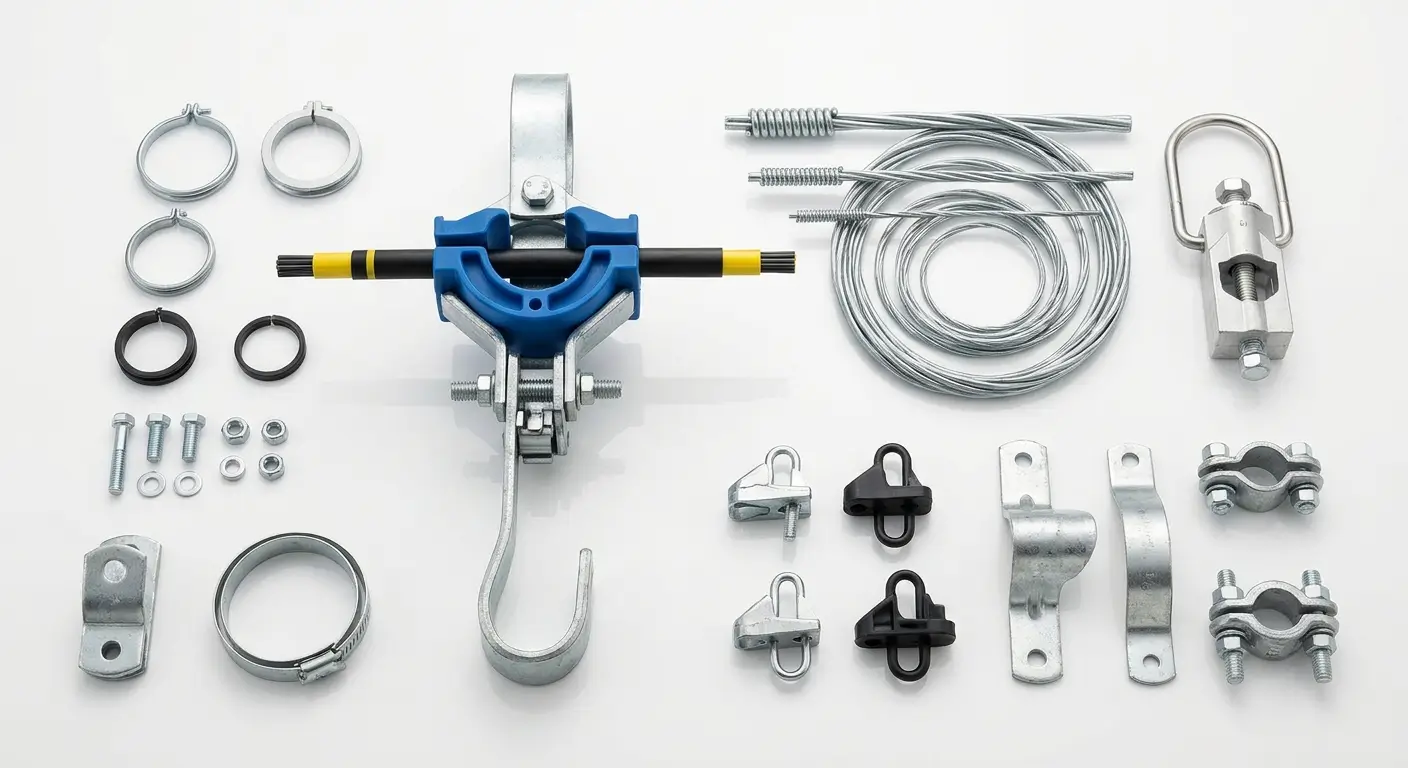
A preformed helical dead-end wraps around the cable like a spiral grip. The more the cable pulls, the tighter it holds, yet the pressure stays distributed along the whole length of the wrap. The other end forms a loop that attaches to the pole through a tension bracket orADSS fittings.
Use dead-ends:
- At the start and end of a route
- At sharp corners and large line angles
- Before and after river, road, or rail crossings
- Wherever the line changes tension or height
Selection tip: Dead-ends are sized for a specific cable diameter range and a rated breaking load. A set that is slightly too large will slip, and one too small will not seat properly.
Along the Route: Suspension Clamps
At intermediate poles on straight sections, the cable only needs support, not anchoring. This is the job of the suspension clamp.
A typical assembly includes:
- Armor rods: Helical rods wrapped around the cable to cushion and protect it
- Clamp body: Usually aluminum alloy, with a rubber or elastomer insert
- Bolts and brackets: Attaching the assembly to the pole
The armor rods are the key. They spread the load and shield the cable from the stress created when it flexes at the clamp. Without them, repeated movement can fatigue the sheath and the aramid-strength members.
For small line angles, a single suspension set is enough. As the angle grows, use a double suspension set, or switch to a dead-end. Always check the maximum angle allowed by the manufacturer.
At Corners and Heavy-Load Points
Where the route turns sharply or the span lengths change significantly, a single clamp can be overloaded. Common solutions include:
- Double dead-end assemblies, with one on each side of the pole
- Angle brackets that align the clamp with the cable direction
- Guying the pole where the cable load is high
Good design avoids concentrated load on one pole. Ask your engineer to run a sag and tension calculation for any complex route.
Controlling Wind Vibration
In open ground, wind blowing across a cable at a steady speed can create fast, small oscillations known as aeolian vibration. The motion is subtle but relentless, and the damage shows up at the support points as fatigue.
Spiral vibration dampers wrap around the cable near each clamp and absorb the vibration energy. They are most valuable on:
- Long spans
- Exposed terrain such as plains, coastlines, and river valleys
- Routes with consistently steady winds
Short spans in sheltered urban areas often need none. Let the span length and terrain guide the decision.
Leaving the Pole: Down-Lead Clamps
At transition points, the cable drops from the aerial line down the pole to a closure, cabinet, or underground duct. Down-lead clamps secure the cable along the pole surface at regular intervals.
They keep the cable tidy, stop it from swinging in the wind, and protect the bend radius. Choose UV-resistant clamps with smooth edges so the sheath is never cut or pinched.
Slack Storage and Closure Mounting
Professional installers always leave spare cable near closures and line ends for repairs. Cable storage brackets hold this slack in a neat coil at a safe bend radius, off the ground and away from traffic.
Closure brackets and straps fix splice closures to the pole or the span at a convenient working height. Poorly supported closures swing, collect water, and become a maintenance headache. Where aerial cable ends in a distribution point, pair it with a suitable FDB/NAP box.
Materials: Where Quality Shows
- Hot-dip galvanized steel for brackets and hardware: strong, but check zinc thickness
- Aluminum alloy for clamp bodies and preformed rods: light and corrosion-resistant
- Stainless steel for bolts, straps, and buckles in coastal or industrial air
- UV-stabilized polymers for guides and inserts
ADSS fittings often fails first at the coating, the bolts, or the rubber insert. In harsh climates, specify higher corrosion protection from the start.
Matching Fittings to Your Cable and Route
Before ordering, confirm these details with your supplier:
- Cable outer diameter: every rod set and clamp is size-specific
- Cable weight and rated tensile strength
- Span length and sag: longer spans need stronger fittings and more damping
- Environmental load: wind, ice, and temperature range
- Sheath type: standard PE or track-resistant (AT) near high-voltage lines
- Rated breaking load of each fitting, with a safety margin above the maximum working tension
Standards such as IEEE 1222 and IEC 60794-4-10 provide design and test references for ADSS fittings and its hardware.
Installation Mistakes That Cause Failures
- Over-tightening bolts until the insert crushes the cable
- Poorly wrapped rods with gaps, crossovers, or misaligned ends
- Mixing parts from different systems that were never designed to work together
- Ignoring bend radius at down-leads and slack coils
- Skipping dampers on exposed long spans
- Insufficient clearance from power conductors or the ground
- No post-installation check after the first wind or temperature cycle
Conclusion
Good ADSS fittings follows a simple logic: anchor the ends with dead-ends, support the middle with suspension clamps, protect against vibration, and manage the cable carefully wherever it leaves the line. Choose each fitting for the exact cable, span, and environment, then install it to specification. That is how an aerial route stays reliable for decades.
Planning an FTTH or aerial fiber project? Explore our fiber distribution & termination boxes and PLC splitters, or XUI for specifications, OEM options, or samples
What is the main difference between a suspension clamp and a dead-end?
A suspension clamp supports the cable on straight sections. A dead-end anchors the cable and carries full tension.
Why are preformed rods used on ADSS?
They distribute the clamping load along the cable and protect it from vibration and local stress.
Can I use the same hardware for different cable diameters?
No. Armor rods and dead-ends are made for specific diameter ranges.
When do I need vibration dampers?
On long spans and in wind-exposed areas. Short, sheltered spans may not need them.
Is ADSS suitable near power lines?
Yes, when the correct sheath and mounting position are used. Confirm with the utility and applicable standards.