

Table of Contents
An ADSS cable can be perfectly made and still fail early if the hardware holding it up is wrong. Once a fiber cable is strung between poles, every clamp and fitting carries mechanical load for years, through wind, ice, sun, and vibration. The cable gets the attention, but the hardware decides how long the line survives.
This guide explains the main ADSS fittings, what each one does, and how to choose them.
What ADSS Hardware
ADSS stands for All-Dielectric Self-Supporting. The cable contains no metal, relying on aramid yarn for strength, so it can be installed on existing power or utility poles without a separate messenger wire. Because there is no metal, it also tolerates high-voltage environments better than metallic aerial cable.
Since the ADSS Hardware carries its own load, the fittings grip a non-metallic, relatively soft structure. They must hold firmly without crushing the cable, which is why ADSS hardware is designed differently from ordinary overhead line hardware.
Why the Right Hardware Matters
- Mechanical load: Hardware transfers cable tension to the pole without overstressing the fibers
- Vibration control: Wind-induced movement can fatigue the cable at its support points
- Protection: Fittings guard the sheath against abrasion and pressure
- Longevity: Corrosion, UV, and temperature swings attack cheap fittings first
- Safety: A failed clamp can drop a cable onto roads or power lines
Core ADSS Fittings
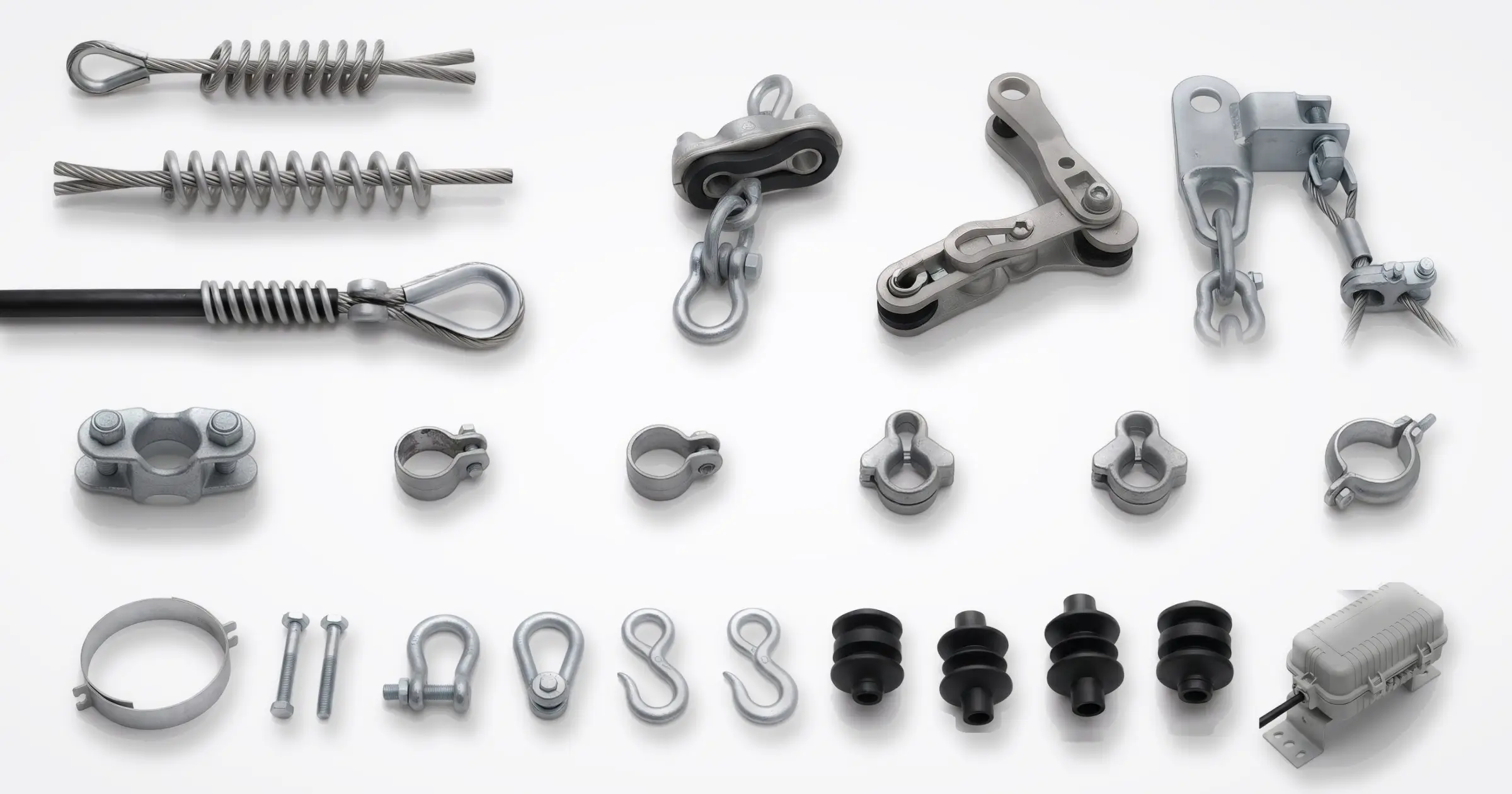
Suspension Clamps
A suspension clamp holds the cable at intermediate poles along a straight run. The cable passes through, supported but not terminated.
The most common design uses preformed helical rods (armor rods) wrapped around the cable, then seated in a clamp body. The rods spread the load over a longer length, reducing local stress and protecting against vibration damage. Suspension clamps suit gentle line angles. Sharp turns need ADSS Hardware.
Dead-End Clamps (Tension Clamps)
Dead-ends anchor the cable at the end of a span, at corners, or where tension changes. They carry the full pull of the cable, so they are the most critical fitting on the line.
The popular choice is the preformed helical dead-end, a set of spiral rods that wrap around the cable and grip evenly along their length. Since it relies on a distributed grip rather than a pinch point, it protects the fibers and the sheath. Dead-ends are used at line terminations, major angles, river crossings, and any section needing strong anchoring.
Down-Lead Clamps
Where the cable leaves the pole and travels down toward a closure or cabinet, down-lead clamps secure it along the pole surface. They keep the cable neat, prevent flapping, and maintain proper bend radius. Spacing is typically regular along the vertical run.
Vibration Dampers
Wind blowing across a cable can cause rapid, small oscillations known as aeolian vibration. Over time this fatigues the cable near its attachment points. Spiral vibration dampers or similar devices dissipate this energy. They are especially useful in open terrain and on long spans.
Cable Slack Storage Brackets
Near joint closures and at line ends, extra cable is stored in a coil for future repairs or splicing. Storage brackets (often called slack holders or cable racks) hold this coil at a safe bend radius so it does not hang loose or kink.
Pole Brackets and Anchoring Hardware
These attach the clamps to the pole. Typical pieces include pole hooks, angle brackets, tension brackets, and through-bolts, along with stainless steel straps and buckles for light-duty mounting.
Joint Closure Mounting ADSS Hardware
Splice closures need secure mounting on the pole or along the span. Brackets and straps hold them at a convenient and safe height, away from traffic and water pooling.
Choosing Materials
Material choice is where cheap and reliable ADSS hardware parts ways.
- Hot-dip galvanized steel: Strong and economical, with a zinc coating for corrosion protection. Check coating thickness.
- Aluminum alloy: Lighter and corrosion-resistant, common for clamp bodies and preformed rods
- Stainless steel: Excellent for coastal or industrial areas, and for straps and bolts
- UV-stabilized plastics: Used for cable guides and some protective parts
Match the material to the environment. Coastal air, chemical exposure, and heavy industrial zones demand higher corrosion resistance than a dry inland route.
Matching Hardware to the Cable
Not every fitting suits every ADSS hardware. Before ordering, confirm:
- Cable outer diameter: Preformed rods and clamps are sized to a specific diameter range
- Cable weight and tensile rating: Hardware must exceed the maximum working tension
- Span length: Short spans (under about 100 m) and long spans (several hundred meters) need different strength and damping
- Sheath type: Standard PE for most use, track-resistant (AT) for high-voltage proximity
- Ice and wind loading: Cold or storm-prone regions raise the required strength
- Line angle: Larger angles may need double suspension or dead-end fittings
Always request the rated breaking load and compare it with the calculated design tension, with a safety margin.
Installation Practices That Prevent Problems
- Follow the sag and tension plan. Over-tightening risks cable damage, while excess sag risks clearance violations.
- Install preformed rods carefully. Align and wrap them evenly, without gaps or crossovers.
- Respect bend radius. This includes down-leads and slack storage coils.
- Keep proper clearance from power conductors and the ground, based on local codes.
- Use dampers where wind exposure is high or spans are long.
- Tighten bolts to specification and inspect after the first season.
- Do not mix brands blindly. Components from different systems may not match in grip and rating.
For electrical environments, use the correct mounting position on the pole and a cable sheath suited to the field strength. Consult your utility and the applicable standards, such as IEEE 1222 and IEC 60794-4-10, for design requirements.
Where Aerial Fiber Connects to the Ground Network
The aerial run eventually transitions to distribution points. Pair the line with a properly rated FDB/NAP box, plus PLC splitters and fiber distribution & termination boxes for complete last-mile builds. After installation, confirm performance with an OTDR test.
Conclusion
ADSS hardware is a system, not a shopping list. Suspension clamps carry the line, dead-ends anchor it, dampers protect it from vibration, and brackets and down-leads keep everything orderly. Match each fitting to the cable diameter, span, environment, and load, then install it to specification. Done right, an aerial fiber route can serve reliably for decades.
What is the difference between suspension and dead-end clamps?
Suspension clamps support the cable along straight runs. Dead-end clamps anchor it at terminations and corners, carrying the full tension.
Are preformed dead-ends better than bolted clamps?
For ADSS Hardware, preformed helical types are widely preferred because they distribute grip over a longer length and protect the cable.
Do I need vibration dampers on every span?
Not always. They are most valuable on long, exposed spans and in windy regions.
Can I use metal power-line hardware on ADSS?
Only if designed or approved for the cable’s diameter and construction. Mismatched hardware can crush or damage the sheath.
What affects span length?
Cable strength, weight, sag limits, and local wind and ice loading.