

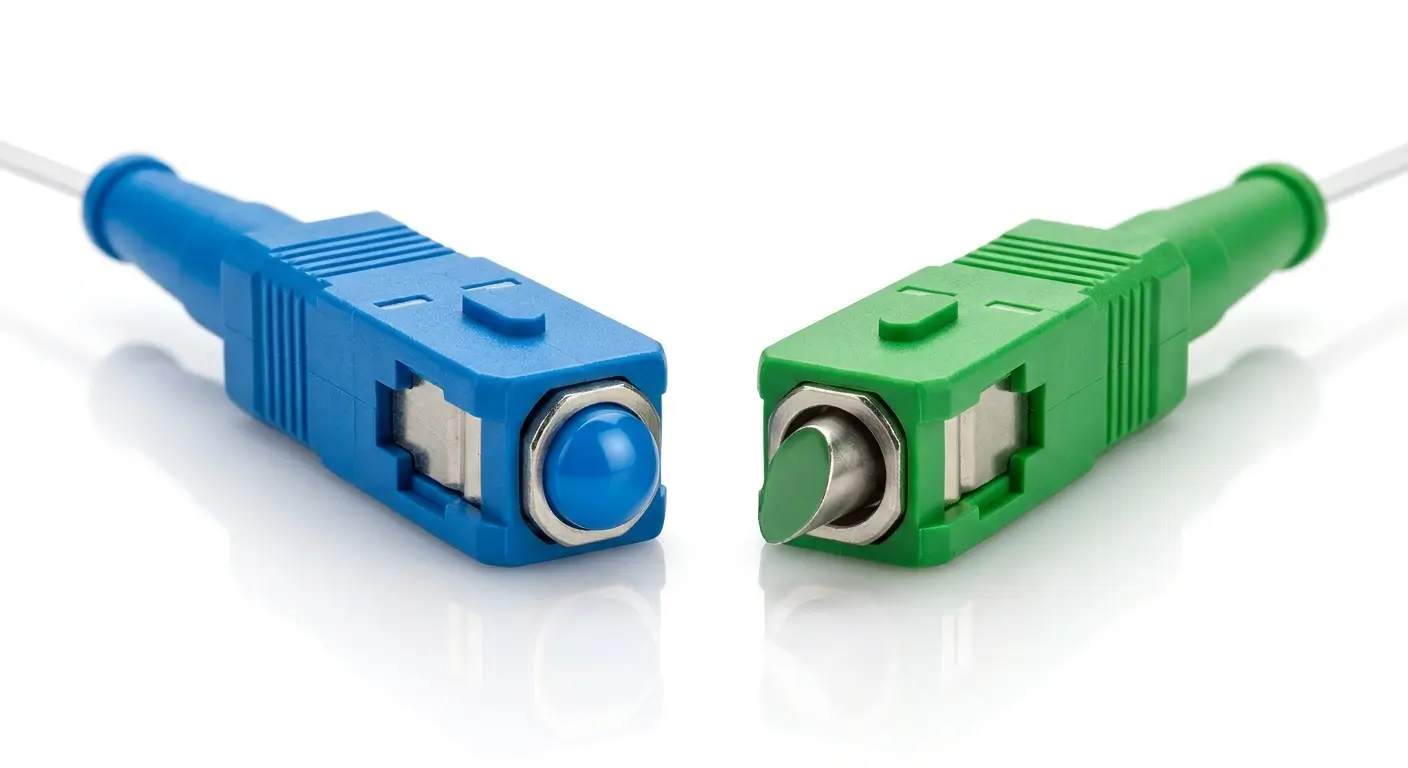
SC/UPC vs SC/APC Return Loss, Colors, and Compatibility. Two SC connectors can look nearly identical, yet one small detail, the angle of the ferrule tip, decides how well your network performs. Pick the wrong one and you may see weak signal, noisy video, or a damaged connector face.
This guide explains how SC/UPC vs SC/APC differ, how to spot them by color, and why you should never mix them.
The Core Difference: A Flat Tip vs an Angled Tip
Both connectors use the same SC body, a push-pull square design with a 2.5 mm ferrule. The difference is how the fiber end-face is polished.
- SC/UPC (Ultra Physical Contact): The end-face is polished with a slight dome and no angle (0°). Light that reflects at the joint travels straight back toward the source.
- SC/APC (Angled Physical Contact): The end-face is polished at an 8° angle. Reflected light bounces into the cladding instead of returning down the core.
That angle is the entire reason APC exists: it sends unwanted reflections somewhere harmless.
Return Loss: Why It Matters
Return loss measures how much light reflects back toward the transmitter, expressed in dB. A higher number is better, because less signal is bouncing back.
- SC/UPC: typically 50 dB or better
- SC/APC: typically 60 dB or better
Ten extra decibels means roughly ten times less reflected light. For most data links this gap is invisible. For sensitive systems it is critical, because strong back-reflection can:
- Disturb laser stability at the transmitter
- Add noise to analog video (CATV) signals
- Reduce the performance of high-power or long-reach links
Insertion loss, the signal lost passing through the connector, is similar for both types, usually around 0.3 dB or less when the connectors are clean and well made.
Colors: How to Tell Them Apart at a Glance
Industry convention makes identification easy:
- Blue → UPC
- Green → APC
This applies to the connector boot or housing and to the matching SC adapters. Many installers also check for a printed SC/UPC vs SC/APC mark on the cord jacket, since colors can vary on custom or OEM products.
Compatibility: Can You Mix SC/UPC vs SC/APC?
The flat and angled faces cannot touch properly. This creates an air gap that causes:
- High insertion loss and strong reflections
- Unstable or failed links
- Possible scratches or damage to the ferrule end-faces
If your network genuinely needs to bridge the two, use a hybrid patch cord (SC/APC on one end, SC/UPC on the other). The connector on each end still mates only with its own type, so the cord does the conversion and the mating faces stay compatible.
Which One Should You Choose?
Choose SC/APC when:
- Building FTTH, GPON, XGS-PON, or EPON networks
- Carrying CATV or RF video overlay (1550 nm)
- Running long-distance or high-power links
- Your equipment ports or splitters are already APC (most PON gear is)
Choose SC/UPC when:
- Connecting digital data links, enterprise LANs, and data center gear that specify UPC
- Working inside short, controlled indoor runs
- Replacing existing UPC components in a UPC-based system
The simplest approach: follow the equipment. Check the port type on your OLT, ONT, splitter, or patch panel, then buy connectors to match. If you are planning a new FTTH build, APC is the standard choice.
Practical Tips for Installers
- Standardize on one type per network segment. It prevents costly mix-ups.
- Clean every connector before mating. Dirt causes more failures than polish type.
- Inspect end-faces with a microscope, especially on APC where scratches hurt return loss.
- Keep dust caps on unused ports and cords.
- Label clearly at distribution boxes and patch panels.
- Check splitters and pigtails in your distribution box. A PLC splitter with UPC outputs feeding APC cords will cause trouble.
Is SC/APC better than SC/UPC?
Not universally. APC offers superior return loss, but UPC is perfectly suitable for many data applications. “Better” depends on what your equipment requires.
Why are APC connectors green?
Green is the industry color code for the angled polish, making it easy to separate APC from blue UPC at a glance.
What happens if I connect UPC to APC by mistake?
You get poor contact, high loss, and strong reflections, and you risk damaging the end-faces. Disconnect and inspect both connectors.
Do SC/UPC and SC/APC have different insertion loss?
Typically no. Both are generally rated around 0.3 dB or less. The key difference is return loss.
Can I tell APC from UPC by looking at the ferrule?
The angle is hard to see by eye. Use the color, the printed label, or a fiber inspection scope.
Which is used in FTTH?
SC/APC is the common standard for FTTH and PON deployments.
Conclusion
SC/UPC vs SC/APC share the same body but serve different jobs. UPC is the flat-polish option for general data links, while APC’s 8° angle delivers higher return loss for PON, FTTH, and video networks.